
1win Platform Analysis – Economic Framework for Risk-Aware Engagement
7Slots Casino – Yksek Kazan Frsatlar.5231
February 16, 2026Live Casino: The Ultimate Guide to Real-Time Gaming and Entertainment
February 16, 20261win – A Structural Overview of the Gaming and Betting Ecosystem
In the contemporary digital landscape, platforms like 1win represent a significant economic segment, merging entertainment with complex transactional dynamics. This analysis provides a structured examination of the 1win platform, assessing its operational framework, user interface, financial mechanics, and integrated risk management protocols. The objective is to furnish a comprehensive, economically-grounded overview that enables informed decision-making, emphasizing the long-term sustainability of user engagement. The platform’s primary portal, accessible via https://1win-casino-azerbaycan.com/, serves as the nexus for these activities, which we will dissect through a lens of economic efficiency and risk assessment.
Architectural Foundation and User Interface Economics
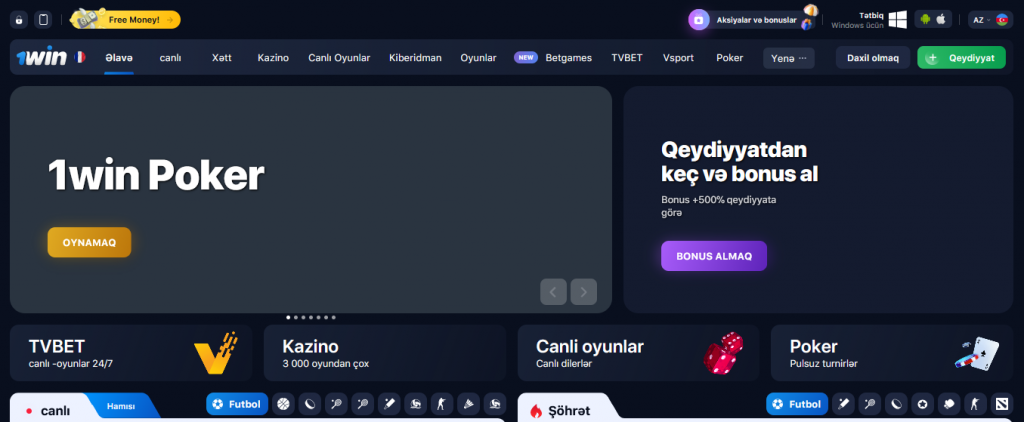
The 1win interface functions as the primary market floor for its services. Its design prioritizes liquidity of access-ensuring users can swiftly navigate between betting markets, casino lobbies, and account management. From an economic perspective, a well-structured interface reduces transaction costs for the user, minimizing time spent searching for assets (events or games) and facilitating clearer price (odds/return) discovery. The platform segregates its offerings into distinct yet interconnected sectors: sports betting, live betting, casino games, and live dealer sections. This compartmentalization allows for specialized risk pools but requires users to consciously allocate their capital across different volatility profiles. The mobile application replicates this economic efficiency, offering a condensed yet fully-functional market access point, crucial for engaging with time-sensitive live events.
1win Registration – The Onboarding Transaction
Initiating an account on 1win is the fundamental transaction that grants access to its ecosystem. The process is designed to minimize initial friction, requiring basic personal and contact data. However, this simplicity belies the subsequent, mandatory step of Know Your Customer (KYC) verification, a critical risk-mitigation mechanism for both platform and user. Economically, registration represents a commitment to future transactions and establishes a contractual relationship where the platform’s utility is exchanged for user participation and data. The efficiency of this process impacts user acquisition costs for the brand and opportunity costs for the potential client.
Capital Allocation – Deposit and Withdrawal Mechanics
The financial conduits of any platform dictate its transactional integrity. 1win supports a diversified portfolio of payment methods, including bank cards, e-wallets, and potentially cryptocurrency, catering to varying preferences for anonymity, speed, and cost. Each method carries distinct economic implications:
- Transaction Velocity: E-wallets and crypto often facilitate faster settlement, reducing the capital’s time in transit and enhancing liquidity for the user.
- Transaction Costs: Some methods may incur fees, effectively acting as a tax on deposits or withdrawals, which diminishes the net capital available for engagement.
- Currency Risk: Operating primarily in Azerbaijani Manat (AZN), the platform localizes economic exposure for domestic users, eliminating foreign exchange risk on deposits, though odds are inherently probabilistic valuations.
Withdrawal protocols are inherently more stringent, involving verification checks. This creates a lag-a settlement period-that users must factor into their personal liquidity management. A robust platform maintains transparent timelines, as opacity here increases perceived counterparty risk.
1win Bonus Structures – Analyzing the Promotional Fiscal Policy
Bonuses and promotions are the expansionary fiscal policy of gaming platforms. 1win employs them as capital injections to stimulate user activity. A risk-aware analysis requires dissecting the terms attached to these incentives, which function as binding economic contracts.
| Promotion Type | Immediate Capital Effect | Long-Term Conditionality | Risk Assessment |
|---|---|---|---|
| Welcome Bonus | Increases initial playing capital | Wagering requirements (x35-x50) | High leverage; requires significant volume to unlock |
| Free Bets | Risk-free speculative position | Winning often returned as bonus funds | Lower risk, but capital remains within ecosystem |
| Cashback | Partial loss recovery | Typically automatic, minimal conditions | Functions as a loss hedge, improving sustainability |
| Reload Bonuses | Recurring capital top-up | Ongoing wagering obligations | Can incentivize over-commitment; requires discipline |
| Tournament Prizes | Competitive yield opportunity | Subject to ranking and rules | High variance return; skill-based component possible |
The critical metric is the wagering requirement, which dictates the volume of economic activity required before withdrawal. This creates a high-multiplier obligation that significantly impacts the probability of converting bonus capital into real, withdrawable funds. Users must calculate the expected value, considering the house edge on games or the built-in margin in betting odds.
Operational Risk and the 1win Security Framework
Trust is the non-tangible asset underpinning any financial ecosystem. 1win’s approach to security and licensing is its credit rating. Operation under a recognized licensing authority (e.g., Curaçao) establishes a regulatory baseline, offering a dispute resolution mechanism. The platform’s employment of SSL encryption secures data in transit, protecting against informational arbitrage by malicious third parties. The comprehensive KYC process, while sometimes perceived as an operational friction, is a fundamental anti-fraud and anti-money laundering (AML) control. It verifies the counterparty’s identity, reducing systemic risk for all participants. Users should view this not as an intrusion but as a collective good that enhances the platform’s long-term viability and safety.
Sustainability Through Responsible Gaming Tools
An often-underestimated aspect of economic sustainability is individual risk management. 1win provides tools such as deposit limits, session reminders, and self-exclusion. These are analogous to circuit breakers in financial markets, allowing users to pre-commit to caps on their exposure. Utilizing these tools transforms engagement from speculative impulse to a budgeted entertainment expenditure, aligning with principles of personal financial stability.

Market Liquidity and Product Depth on 1win
The breadth of markets offered-from global sports events to hundreds of casino game variants-indicates high product liquidity. In betting, a deep market with many betting options (lines) allows for more precise risk positioning. In the casino, a wide selection of games from multiple software providers (like NetEnt, Pragmatic Play) diversifies the supply chain, reducing dependency on a single “game economy” and offering varied volatility (variance) profiles. Live dealer games introduce a human element, reducing reliance on Random Number Generator (RNG) algorithms alone, which can affect perceived trust, though both are rigorously audited for fairness.
- Sportsbook: Covers major and niche sports, providing continuous market hours.
- Live Betting: Represents a high-frequency trading environment requiring rapid decision-making.
- Slots: High-variance products with defined Return to Player (RTP) percentages, a key economic indicator.
- Table Games: Lower-house-edge options like blackjack or baccarat allow for more strategic capital deployment.
- Virtual Sports: Offer constant market availability, independent of real-world schedules.
1win Support Infrastructure – The Dispute Resolution Mechanism
Customer support is the platform’s judicial system, resolving transactional disputes and clarifying contractual terms (bonus rules). Its availability (24/7), responsiveness, and competence directly impact the cost of conflict resolution for the user. Efficient support reduces the time and emotional capital spent on issues, preserving the user’s overall utility derived from the platform. Channels typically include live chat, email, and sometimes telephone, with live chat offering the most immediate settlement for urgent matters.
The Long-Term Economic Calculus of Platform Engagement
Ultimately, sustained engagement with 1win, or any similar platform, is a repeated game with probabilistic outcomes. The house edge or bookmaker’s margin is a structural economic reality that ensures the platform’s profitability over the long run. Therefore, the user’s strategy should not be predicated on guaranteed profit but on the efficient allocation of a predefined entertainment budget. The platform’s tools, transparent terms, game fairness certifications, and responsible gaming features are variables that can optimize the user’s experience within this immutable economic framework. A disciplined approach, treating stakes as sunk costs for entertainment rather than investment capital, is the most sustainable model for interaction.
Concluding Synthesis – 1win as a Managed Economic Environment
This structural overview positions 1win not merely as an entertainment portal but as a complex micro-economy. It features capital inflows and outflows (deposits/withdrawals), fiscal stimulus (bonuses), regulatory oversight (licensing/KYC), risk management tools, and a diverse market of speculative instruments (bets/games). The platform’s design aims to balance user attraction with operational sustainability. For the Azerbaijani user, the localization to AZN and regional payment methods reduces transactional friction. Success in this environment, defined as sustained, controlled engagement, is less about luck and more about understanding these underlying economic and risk parameters, utilizing the platform’s features to enforce personal budgetary discipline, and always acknowledging the probabilistic nature of all outcomes.
